Your email will be used for sending Abandoned Cart emails
Buying a Business Is Easy. Accounting for It Is Not. IFRS for SMEs Section 19
Date:
14 July, 2026
Time:
14:00
Hours:
2 hours
CPD Units:
2
Category:
Accounting
Group:
Channel 2: Growth
Format:
Live Event
Business combinations create long-term reporting problems when goodwill is misunderstood. This session explains how acquisitions should be accounted for and why errors last for years.
How to get this session: CIBA members access it through their channel, log in and find it under My CPD. Not a member yet? Buy this single session, or join CIBA to unlock your full channel
Business combinations often look straightforward at the transaction date, but accounting mistakes follow for years. Goodwill is overstated. Impairment is ignored. Disclosures are weak. This session focuses on how Section 19 of IFRS for SMEs applies when businesses are acquired or merged. Attention is given to identifying the transaction correctly, measuring consideration, and calculating goodwill accurately. Understanding how goodwill behaves after the acquisition date is critical to avoiding overstated assets and future surprises. This session strengthens confidence in dealing with acquisitions and ensures that business combinations are reflected clearly, consistently, and defensibly.
Presenter/s
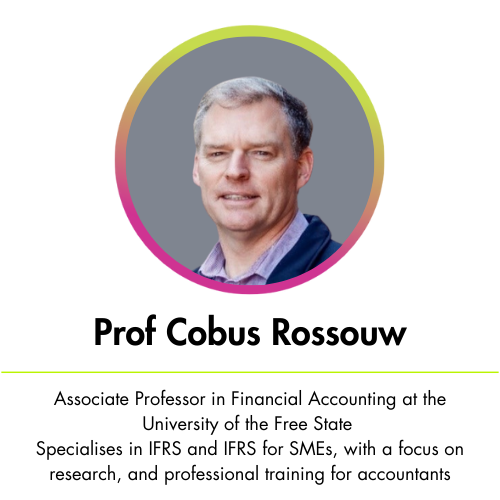
Prof. Cobus Rossouw
Associate Professor in Financial Accounting at the University of the Free State. Specialises in IFRS and the IFRS for SME’s, with a focus on research and professional training for accountants.
What will set you apart
What actually counts as a business combination
How purchase consideration is measured
How goodwill is calculated properly
Why goodwill creates ongoing risk
How impairment affects profit
Where acquisitions are commonly misstated
Event breakdown
Identifying a business combination
Determining the acquirer
Measuring consideration
Recognising assets and liabilities
Calculating goodwill
Subsequent treatment of goodwill
Impairment considerations
Disclosure requirements
Certificate
The following event is awarded 3 CPD units in Accounting.