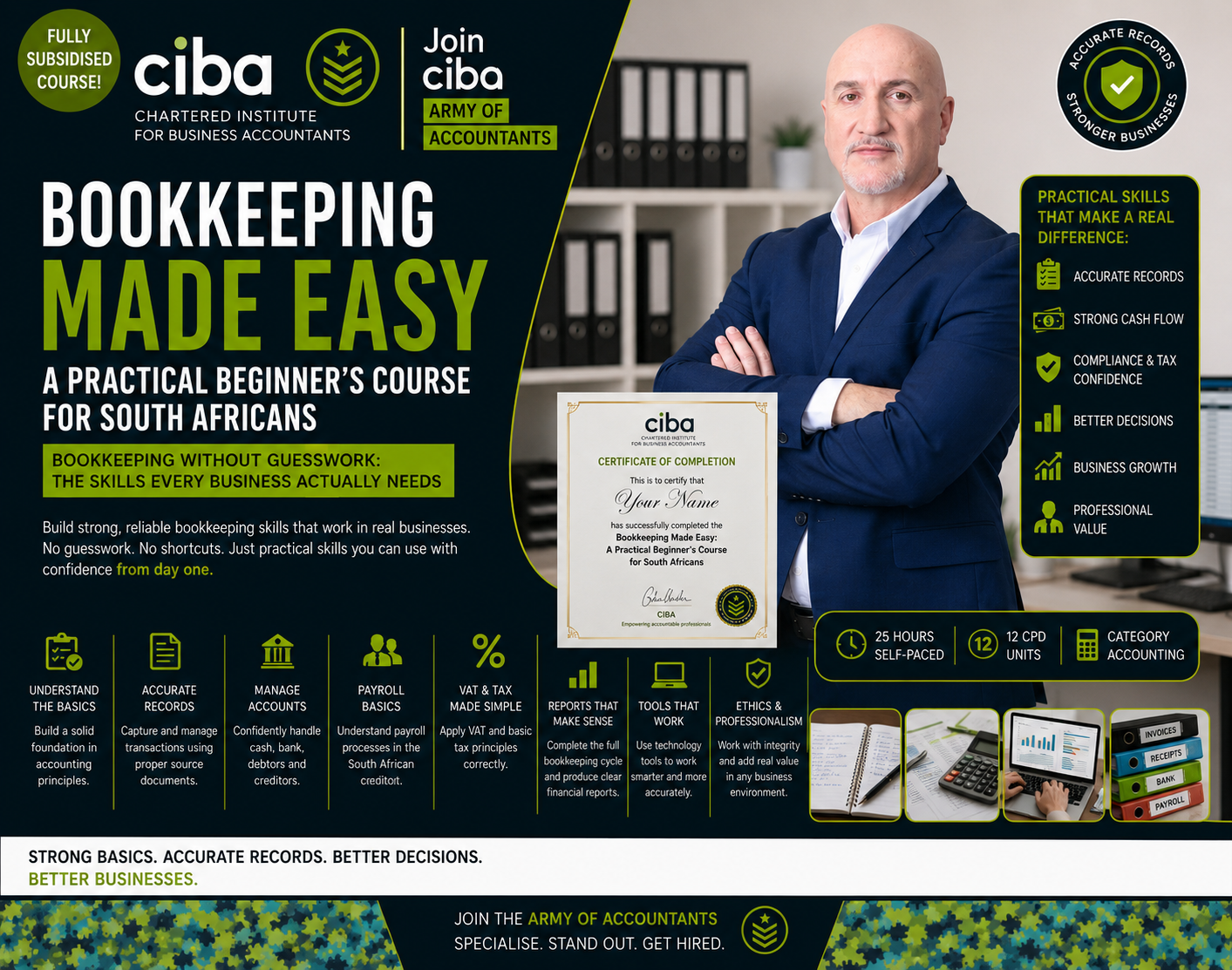
The purpose of this course is to build strong, reliable bookkeeping skills that work in real business environments. It exists to eliminate guesswork, reduce errors, and create bookkeepers who understand the impact of their work on cash flow, tax, compliance, and decision-making.
Valued at R2 300 – yours for R0.
CIBA fully subsidises this course because every South African who can balance a ledger is one step closer to running a business, getting hired, or helping their community manage money properly. No catch, no hidden fees, just the skills, on us.
Most bookkeeping problems don’t come from complex accounting rules, they come from weak basics. Missing documents, poor records, confused VAT, incorrect payroll, and numbers no one trusts. This course fixes that.
This course teaches bookkeeping the way it is used in real businesses. It focuses on understanding what you are doing, why you are doing it, and how each step affects the next one. You are taken through the full bookkeeping process, from capturing source documents to producing basic financial reports, without shortcuts or assumptions.
By the end of the course, you will no longer “just capture data”. You will understand the flow of transactions, spot errors early, and keep records that business owners, accountants, and auditors can rely on.
Who This Course Is For
This course is not for advanced accountants or theory-driven study.
Valued at R2 300 – yours for R0.
CIBA fully subsidises this course because every South African who can balance a ledger is one step closer to running a business, getting hired, or helping their community manage money properly. No catch, no hidden fees, just the skills, on us.

After completing this course, you will be able to:
The course follows the real bookkeeping workflow used in small businesses:
| Chapter | Description |
| 1 | Introduction to Bookkeeping |
| 2 | Accounting Basics |
| 3 | Source Documents and Recordkeeping |
| 4 | Journals and Ledgers |
| 5 | Cash and Bank Management |
| 6 | Debtors and Creditors (Revenue and Supplier Cycles) |
| 7 | The Accounting Cycle in Practice |
| 8 | Payroll Basics in the South African Context |
| 9 | VAT and Basic Tax |
| 10 | Financial Reporting for Small Entities |
| 11 | Technology Tools for Bookkeepers |
| 12 | Budgeting Basics |
| 13 | Ethics and Professionalism |
Each chapter builds practical skill and reinforces accuracy and control.

After completing the short course you will receive a CIBA certificate of completion with 12 verifiable units in Bookkeeping.
+27 (0) 12 643 1800/2/4 ciba@myciba.org www.myciba.org
Gauteng: Spaces, Byls Bridge Office Park, Building 14 Block B, Cnr of Olievenhoutbosch Road and Jean Avenue, Centurion, 0157
Cape Town: Cape Town Spaces Office, Century City, No1 Bridgeway Road, Bridgeways Precinct, Cape Town, 7441
Namibia: Regus Office Windhoek, Maerua Mall 3rd Floor, Windhoek, Namibia, 10005
Paris: I13 Rue Paul Valéry, 75116 Paris, France (ICFOA)